


Why Brand Consistency Shapes Customer Trust
Updated: 7 days ago
Trust is built when what a business promises, communicates and delivers remains coherent across channels, teams and customer interactions.

Key Takeaways
Brand consistency extends beyond logos, colours and messaging. Customers judge a business through its products, service, pricing, employees, digital experience and operational delivery.
Consistency can strengthen trust because repeated, coherent experiences make a business more predictable and reduce uncertainty about what customers can expect.
Many of the inconsistencies that weaken a brand originate inside the organisation. Aligning strategy, people, technology and operations is therefore as important as maintaining a consistent visual identity.
For leaders, the goal should not be perfect sameness across every interaction. It should be coherence between what the business promises and what customers actually experience.
Most conversations about brand consistency begin with visual identity.
Businesses are told to use the same logo, maintain their colours, follow typography guidelines and communicate in a recognisable tone of voice. These disciplines matter. A coherent identity helps customers recognise a business and can reinforce the associations the organisation wants to build over time.
But visual consistency is only one layer of a much larger issue.
Customers do not experience a brand only through advertising or design. They experience it when they visit a website, speak to an employee, receive a quotation, make a payment, use a product, contact support, wait for a delivery or attempt to resolve a problem.
Each interaction provides another piece of evidence about what the organisation is actually like.
A company may describe itself as simple while making customers navigate complicated processes. It may position itself as premium while providing inconsistent service. It may promise transparency while presenting customers with unexpected charges or unclear information.
In each case, the problem is not simply inconsistent communication. It is a contradiction between the promise and the experience.
This is why brand consistency should be understood as more than a marketing discipline.
Brand consistency is the disciplined reduction of contradiction between what a business promises and what customers experience.
When those two things repeatedly reinforce each other, customers gain a clearer understanding of what the organisation represents and what they can reasonably expect from it.
That predictability can become an important foundation for trust.
Why consistency can strengthen customer trust
Customers rarely have complete information when making a decision about a business.
Before buying again, renewing a contract, recommending a company or choosing one provider over another, they are making a judgement about what is likely to happen next. Previous interactions help them make that judgement.
If a company repeatedly communicates clearly, delivers what it promises, provides a recognisable standard of service and responds to problems in a reasonably consistent way, customers accumulate evidence about its behaviour.
Over time, that evidence makes the organisation more predictable.
Predictability matters because uncertainty creates friction. A customer who is unsure whether a business will deliver on time, honour its commitments or provide adequate support must accept more perceived risk when choosing that company.
A customer who has repeatedly experienced dependable behaviour has more evidence on which to base the next decision.
Trust therefore does not have to begin with an emotional attachment to a brand. It can begin much more practically: with repeated evidence that the organisation behaves in a dependable way.
This is increasingly commercially relevant.
Edelman's 2026 global brand research found that 89% of surveyed consumers regarded trusting a brand as important or a critical deal-breaker when considering a purchase. Trust ranked broadly alongside considerations such as quality and value for money.

The South African findings are equally notable. Edelman reported in 2025 that 84% of South Africans trusted the brands they personally use to do what is right, while broader trust in brands had increased from 53% in 2022 to 72% in 2025.

These findings should not be interpreted to mean that trust alone determines purchasing behaviour. Price, product quality, availability, convenience, competition and individual preferences remain important.
They do, however, suggest that trust has become difficult to separate from the commercial proposition itself.
For business leaders, this changes the question.
Rather than asking only, "How can we make our brand appear more trustworthy?", organisations should also ask:
"What evidence does our business repeatedly give customers that we are dependable?"
That evidence is produced across the organisation.
Where inconsistency becomes visible to customers
One of the difficulties with brand management is that businesses are organised into departments, while customers generally experience one company.
A customer does not necessarily care that marketing, sales, operations and customer support use different systems, report to different executives or operate according to different internal processes.
From the customer's perspective, those departments represent the same organisation. This distinction matters.
A strong advertising campaign followed by a poor service interaction is not experienced as good marketing and weak operations. It is experienced as a company failing to meet the expectation it created.
A personalised sales process followed by an impersonal and confusing onboarding experience creates the same problem. So does a modern website connected to outdated manual processes, or a promise of rapid service followed by slow internal approvals.
Research into customer experience repeatedly shows how operational these problems can be.
Qualtrics' 2025 consumer research identified service delivery issues, communication problems, employee interactions, pricing concerns and product failures among the most common sources of negative customer experiences.

PwC's 2025 Customer Experience Survey similarly found that poor experiences can have direct behavioural consequences, with consumers reporting that they had stopped buying from businesses after unsatisfactory product, service or customer experiences.
The implication is important: many of the experiences that shape brand trust are not controlled by the brand or marketing team.
They are produced by systems, processes, policies, technology and people.
A business can therefore have a highly consistent visual identity and still have an inconsistent brand.
Internal inconsistency becomes external inconsistency
As organisations grow, contradictions become easier to create.
New teams develop their own processes. Different departments adopt different systems. New employees interpret the company's values differently. Sales teams may make promises that operations struggle to fulfil. Websites are updated while internal documents remain outdated. Customer information may sit across systems that do not communicate effectively.
Individually, many of these issues appear operational.
Collectively, customers experience them as the brand.
This is where the relationship between brand strategy and organisational design becomes important.
If a business wants customers to associate it with simplicity, then simplicity must eventually influence its processes.
If the positioning is based on responsiveness, the organisation must have the people and systems required to respond quickly.
If transparency is central to the brand, pricing, communication and policies should make information easier for customers to understand.
The stronger the external promise, the more important the internal capability to deliver it becomes.
What South African businesses can learn from consistency
Two familiar South African businesses illustrate different dimensions of this principle.
Capitec has long built much of its market proposition around making banking simpler, more transparent and more accessible. Those ideas are not confined to its advertising. They have also influenced product design, pricing, digital banking and the broader customer proposition.
In its 2026 reporting, Capitec continued to describe simplicity, transparency and affordability as important elements of its approach while serving more than 25 million active clients.
Capitec's growth should not be attributed to brand consistency alone. Competitive dynamics, technology investment, pricing, distribution, product development and broader changes in the banking market have all played a role.
What makes the example useful is the coherence between the strategic proposition and multiple parts of the operating model.
The message and the mechanism reinforce one another.
Checkers Sixty60 illustrates a different type of consistency.
Its proposition is strongly associated with convenience and rapid grocery delivery. In that context, logistics is not merely a back-office function supporting the brand.
Logistics is part of the brand.
Inventory accuracy, picking, fulfilment, app performance and delivery all determine whether the customer experiences the convenience being promised.
Advertising can introduce the proposition, but operations ultimately validate it.
The same principle applies beyond retail or financial services.
A professional-services business promising responsiveness requires responsive communication systems. A technology company positioning itself around simplicity cannot create unnecessarily complicated onboarding. A premium hospitality business must ensure its service behaviour matches the standard communicated through its marketing.
In each case, the brand promise becomes credible when the business is capable of delivering it consistently.
From brand promise to operating standard

A useful way for organisations to assess consistency is to examine five interconnected dimensions of the brand.
Dimension | What it means | A question for leaders |
Identity consistency | The organisation remains recognisable through its visual and verbal presentation. | Do customers consistently recognise who we are and how we communicate? |
Promise consistency | The organisation communicates a clear and stable value proposition. | Is it clear what customers should expect from us? |
Experience consistency | Customer interactions reinforce rather than contradict the proposition. | Does the experience match what our marketing and sales teams promise? |
Behavioural consistency | Employee and organisational behaviour reflects the values the company communicates. | Do our actions support what we say we believe? |
Operational consistency | Systems and processes enable the organisation to deliver its proposition reliably. | Can the business repeatedly deliver the standard the brand promises? |
These dimensions are connected.
Identity may create recognition. The proposition creates an expectation. The customer experience tests that expectation. Employee behaviour gives the organisation a human expression. Operations determine whether the promise can be delivered reliably and at scale.
The strongest brands therefore tend to be supported by more than effective communication.
They are supported by organisational coherence.
This also provides a more practical way to think about brand measurement.
If a brand promises speed, leaders should eventually be able to examine response times or turnaround times.
If it promises simplicity, measures such as customer effort, abandonment or the number of steps required to complete important tasks may become relevant.
If transparency is central to the proposition, complaints about unclear pricing, unexpected charges or confusing communication provide useful signals.
If the organisation promises reliability, metrics such as fulfilment accuracy, uptime, first-time resolution or service consistency become part of the brand conversation.
A brand promise becomes significantly more useful when the organisation can translate it into observable standards.
The cost of accumulated contradiction
Not every inconsistent experience immediately destroys trust.
Customers understand that organisations make mistakes.
The greater risk comes from accumulation.
When customers repeatedly encounter gaps between what a business says and what it does, the organisation begins to build what we describe at Avelorium as trust debt.
Trust debt is not a formal financial metric. It is a way of describing the accumulated effect of unresolved contradictions between a company's promises and the experience it delivers.
A business may create trust debt when it repeatedly promises fast service but responds slowly, describes itself as customer-focused while making complaints difficult to resolve, or claims simplicity while adding unnecessary complexity to customer interactions.
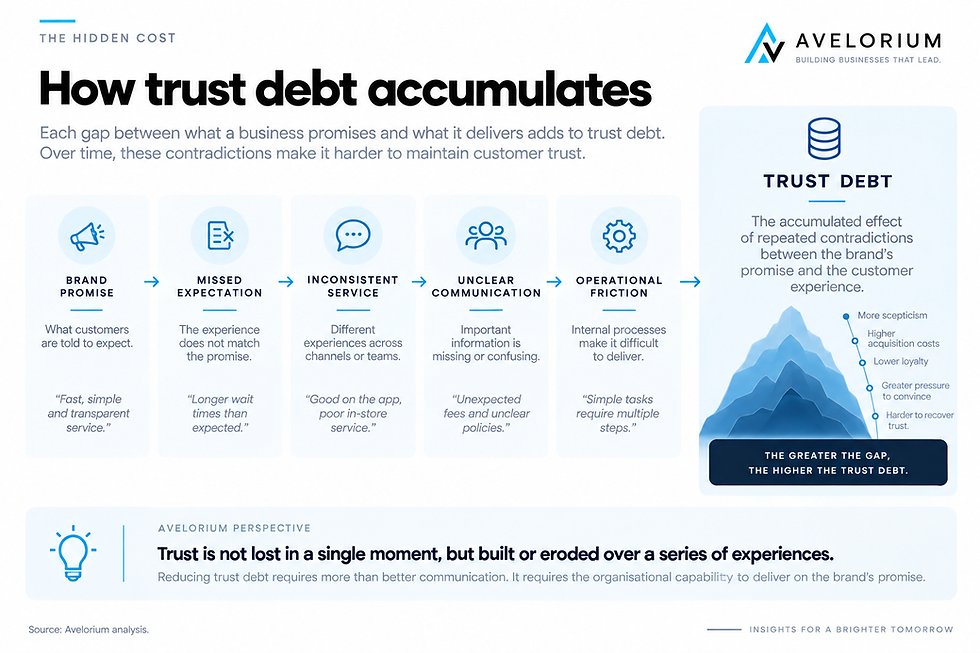
As those contradictions accumulate, the business has to work harder to persuade customers that its promises should still be believed.
This has another important implication: marketing alone cannot repair every trust problem.
When the source of inconsistency is operational, the solution may require process redesign. When it results from poor internal alignment, it may require leadership and employee communication. When fragmented technology creates inconsistent experiences, the answer may involve systems integration or automation.
The source of the problem should determine the intervention.
What leaders should do
Businesses do not need identical customer interactions in every situation. They need the important parts of the organisation to reinforce the same underlying expectation.
A practical starting point is to:
Define the core customer promise. Identify what customers should consistently be able to expect from the organisation in practical terms.
Map where that promise is experienced. Examine the customer journey and identify the interactions where the proposition becomes tangible.
Look for contradictions. Compare what marketing and sales communicate with what customers actually experience through operations, technology, service and employees.
Prioritise the gaps that matter most. Not every inconsistency deserves equal attention. Focus on those affecting important customer moments, commercial outcomes or the credibility of the proposition.
Align teams around the same expectation. Employees should understand not only the company's values and positioning, but what those ideas mean for their own decisions and behaviour.
Connect promises to measures. Where possible, translate important elements of the proposition into operational or customer-experience indicators that can be monitored over time.
The objective is not to turn branding into a rigid set of rules.
It is to make the organisation more deliberate about the relationship between strategy, communication and delivery.
Consistency is not sameness
Strong brands evolve.
Products change. Technology advances. Customer expectations shift. New markets emerge. Visual identities are refreshed. Businesses introduce new services and redesign the way they operate.
Consistency should not prevent that evolution.
The objective is not for every advertisement, interaction or employee to behave identically. It is for the organisation to remain coherent as it changes.
A brand associated with simplicity can introduce sophisticated technology while keeping the customer experience simple. A company known for personal service can automate routine processes while preserving human interaction where it matters. A growing organisation can introduce new products without abandoning the principles that made customers trust it in the first place.
The challenge is therefore not to preserve sameness.
It is to preserve meaning.
When what an organisation says, does and delivers repeatedly points in the same direction, customers have less contradiction to interpret and more evidence on which to base their expectations.
Over time, that coherence can make the organisation easier to understand, easier to predict and easier to trust.
Brand consistency should therefore not be treated simply as a visual standard or marketing guideline.
It is a business discipline.
Sources & Methodology
This article draws on published consumer research, customer-experience studies and company reporting. External findings are used to establish context and evidence; the analysis, frameworks and interpretation presented in this article are Avelorium's own.
Edelman — 2026 Trust Barometer Special Report: Brand Growth in an Insular World Global research examining trust, relevance and consumer relationships with brands.
Edelman — 2025 Trust Barometer Special Report: Brand Trust, South Africa South African findings examining consumer trust in brands and changes in trust over time.
Qualtrics — 2025 Consumer Experience Trends International consumer research examining customer experience, trust, loyalty and the causes of negative customer interactions.
PwC — 2025 Customer Experience Survey Consumer research examining customer expectations, experience and the consequences of poor product and service interactions.
Salesforce — State of the Connected Customer Research examining evolving customer expectations, including consistency across departments and channels.
Capitec — Integrated Annual Report 2026 Company reporting covering Capitec's strategy, customer growth, digital adoption and emphasis on simple, transparent and affordable financial services.